Thinking & Perception
Adaptive Bias
The notion that the human brain has evolved to reason adaptively, rather than truthfully or even rationally, and that cognitive bias may have evolved as a mechanism to reduce the overall cost of cognitive errors as opposed to merely reducing the number of cognitive errors, when faced with making a decision under conditions of uncertainty.
Advance Organizer
A learning tool used to introduce a topic and illustrate the relationship between what the people are about to learn and the information they have already learned.
Affect Heuristic
A mental shortcut where current emotions — fear, pleasure, dread, comfort — serve as a rapid guide for judgments and decisions, often bypassing slower analytical reasoning.
Ambiguity Effect
A cognitive bias where decision making is affected by a lack of information, or "ambiguity". The effect implies that people tend to select options for which the probability of a favorable outcome is known, over an option for which the probability of a favorable outcome is unknown.
Anchoring
Focalism · Focusing Effect
A cognitive bias that describes the tendency for an individual to rely too heavily on an initial piece of information offered (the "anchor") when making decisions.
Apophenia
The tendency to mistakenly perceive connections and meaning between unrelated things. It has come to imply a universal human tendency to seek patterns in random information.
Attentional Bias
The tendency to pay disproportionate attention to certain stimuli — particularly those that are emotionally salient, threatening, or personally relevant — while ignoring others.
Attribute Substitution
Substitution Bias
A mental shortcut in which a person faced with a hard question unconsciously answers an easier, related one instead — without realizing a swap has occurred.
Authority Bias
The tendency to attribute greater accuracy and authority to the opinion of an authority figure and be more influenced by that opinion. The 1961 Milgram experiment in 1961 is widely cited as evidence of this bias (though this study has more recently been called into question).
Availability Heuristic
Availability Heuristic
The tendency to judge the likelihood of events based on how easily examples come to mind, rather than on actual probability or statistical data.
Baader-Meinhof Phenomenon
Frequency Illusion · Frequency Effect
The illusion in which a word, a name, or other thing that has recently come to one's attention suddenly seems to appear with improbable frequency shortly afterwards.
Backfire Effect
Cognitive bias that causes people who encounter evidence which challenges their beliefs to reject that evidence, and to strengthen their support of their original stance.
Base Rate Neglect
Base Rate Fallacy
If presented with related base rate information (i.e. generic, general information) and specific information (information pertaining only to a certain case), the mind tends to ignore the former and focus on the latter.
Bezold Effect
An optical illusion where a color may appear different depending on its relation to adjacent colors.
Biophilia Effect
Biophilia Hypothesis
The measurable positive effects — reduced stress, improved focus, elevated mood — that humans experience when exposed to nature or natural elements, even artificial ones like a plant in an office or a nature screensaver.
Boundary Extension
A memory distortion in which people remember seeing more of a scene than was actually shown — as if the camera had been pulled back slightly, expanding the boundaries of the image.
Call of the Void
Intrusive Thought
The experience of a sudden urge to act on an impulse that is precisely what your judgment is telling you not to do, such as overlooking from a tall height or the urge to pull a fire alarm for no reason.
Change Bias
After an investment of effort in producing change, remembering one's past performance as more difficult than it actually was.
Choice Overload
Overchoice
A cognitive process in which people have a difficult time making a decision when faced with many options.
Chronostasis
Stopped Clock Illusion
A type of time illusion in which the first impression following the introduction of a new event or task-demand to the brain can appear to be extended in time.
Chunking
In cognitive psychology, a process by which individual pieces of information are bound together into a meaningful whole, often used for memorization and mnemonics.
Cocktail Party Effect
Cocktail Party Problem · Selective Hearing
The phenomenon of the brain's ability to focus one's auditory attention on a particular stimulus while filtering out a range of other stimuli, as when a partygoer can focus on a single conversation in a noisy room.
Cognitive Biases
The overarching term for all tendencies to think in certain ways that can lead to systematic deviations from a standard of rationality or good judgments.
Cognitive Dissonance
The mental discomfort experienced by a person who simultaneously holds two or more contradictory beliefs, ideas, or values, such as by a situation in which a belief of a person clashes with new evidence perceived by that person.
Confabulation
In psychology, the production of fabricated, distorted, or misinterpreted memories about oneself or the world, without the conscious intention to deceive.
Confirmation Bias
Confirmatory Bias · Myside Bias
The tendency to search for, interpret, favor, and recall information in a way that confirms one's preexisting beliefs or hypotheses, while giving disproportionately less consideration to alternative possibilities.
Consistency Bias
Incorrectly remembering one's past attitudes and behavior as resembling present attitudes and behavior.
Context Effect
Cue-Dependent Forgetting · Mood-congruent Memory Bias · Constructive Perception
Aspect of cognition where one is influenced by environmental factors in the perception of a given stimulus. In other words, the effects of a given context can impact our learning abilities, word recognition, and memory.
Contrast Effect
The enhancement or diminishment of perception, cognition or related performance as a result of successive (immediately previous) or simultaneous exposure to a stimulus of lesser or greater value in the same dimension.
Cryptomnesia
Unconscious Plagiarism
The instance of a forgotten memory returning without it being recognized as such by the subject, who believes it is something new and original.
Curse of Knowledge
Tappers and Listeners
The difficulty of imagining what it's like not to know something you already know. Experts chronically overestimate how well others understand them because they can't un-know their own expertise.
Denomination Effect
A form of cognitive bias relating to currency, suggesting people may be less likely to spend larger currency denominations than their equivalent value in smaller denominations.
Depth of Processing
The notion that memory recall of stimuli is a function of the depth of mental processing. Deeper levels of analysis (such as tethering it one's own life or context) produce more elaborate, longer-lasting, and stronger memory traces than shallow levels of analysis (such as rote memorization or visual memorization).
Doorway Effect
Location-Updating Effect
The phenomenon that walking through a doorway leads one to forget their current task at hand.
Dunning-Kruger Effect
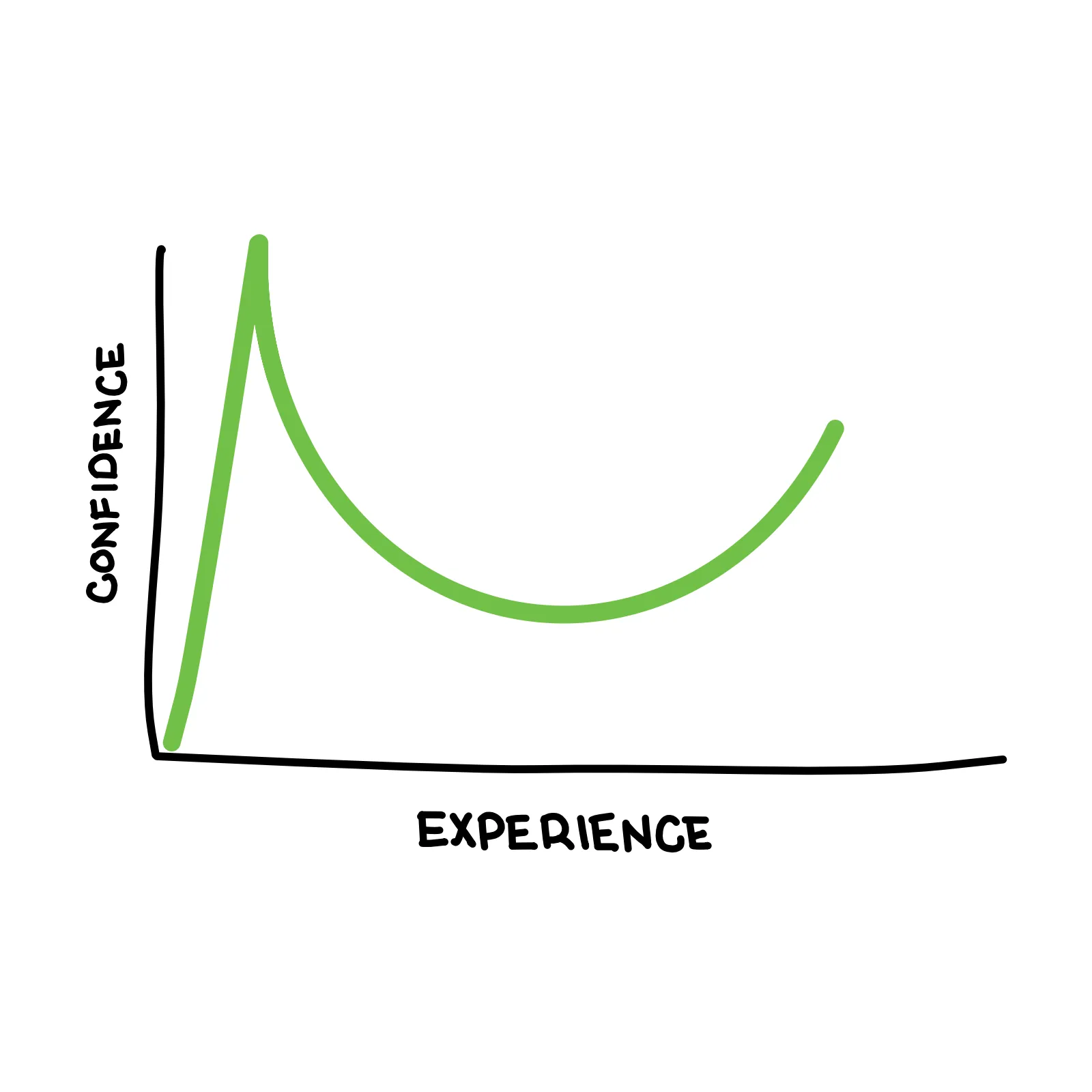
People with limited ability at a task tend to greatly overestimate their competence, while highly skilled people often underestimate theirs. The less you know, the more confident you feel about knowing it.
Duration Neglect
Peak-End Rule
The psychological observation that people's judgments of the unpleasantness of painful experiences depend very little on the duration of those experiences. Such judgments tend to be affected by two factors: the peak (when the experience was the most painful), and how quickly the pain diminishes.
Ear Worm
Brainworm · Stuck Song Syndrome
A catchy piece of music that continually repeats through a person's mind after it is no longer playing.
Emotion Contagion
Emotional Contagion
The phenomenon where emotional states can be transferred to others via emotional contagion, leading them to experience the same emotions as those around them.
Esprit De L'escalier
Staircase Wit
French term ("staircase wit") describing the feeling one has when thinking of the perfect reply — but a moment too late when one is already headed away from the moment.
Exaggerated Expectation
A more extreme version of confirmation bias (interpreting information in such a way that it confirms a preconception), where the reality, when compared to real-world evidence, turns out to be less severe or extreme than the expectations.
Fading Affect Bias
A psychological phenomenon in which information regarding negative emotions tends to be forgotten more quickly than that associated with pleasant emotions.
False Memory
A psychological phenomenon where a person recalls something that did not happen or differently from the way it happened.
Fear, Uncertainty, and Doubt (FUD)
A disinformation strategy used in sales, marketing, public relations, politics and propaganda, where one is trying to influence perception by disseminating negative and dubious or false information and a manifestation of the appeal to fear.
Framing Effect
A set of concepts and theoretical perspectives on how individuals, groups, and societies, organize, perceive, and communicate about reality.
Fresh Start Effect
The cognitive phenomenon where people are more likely to take action towards a goal after temporal landmarks that represent new beginnings, such as a new home, new workplace, or even walking through a doorway.
Functional Fixedness
A cognitive bias that limits a person to use an object only in the way it is traditionally used.
Gaslight
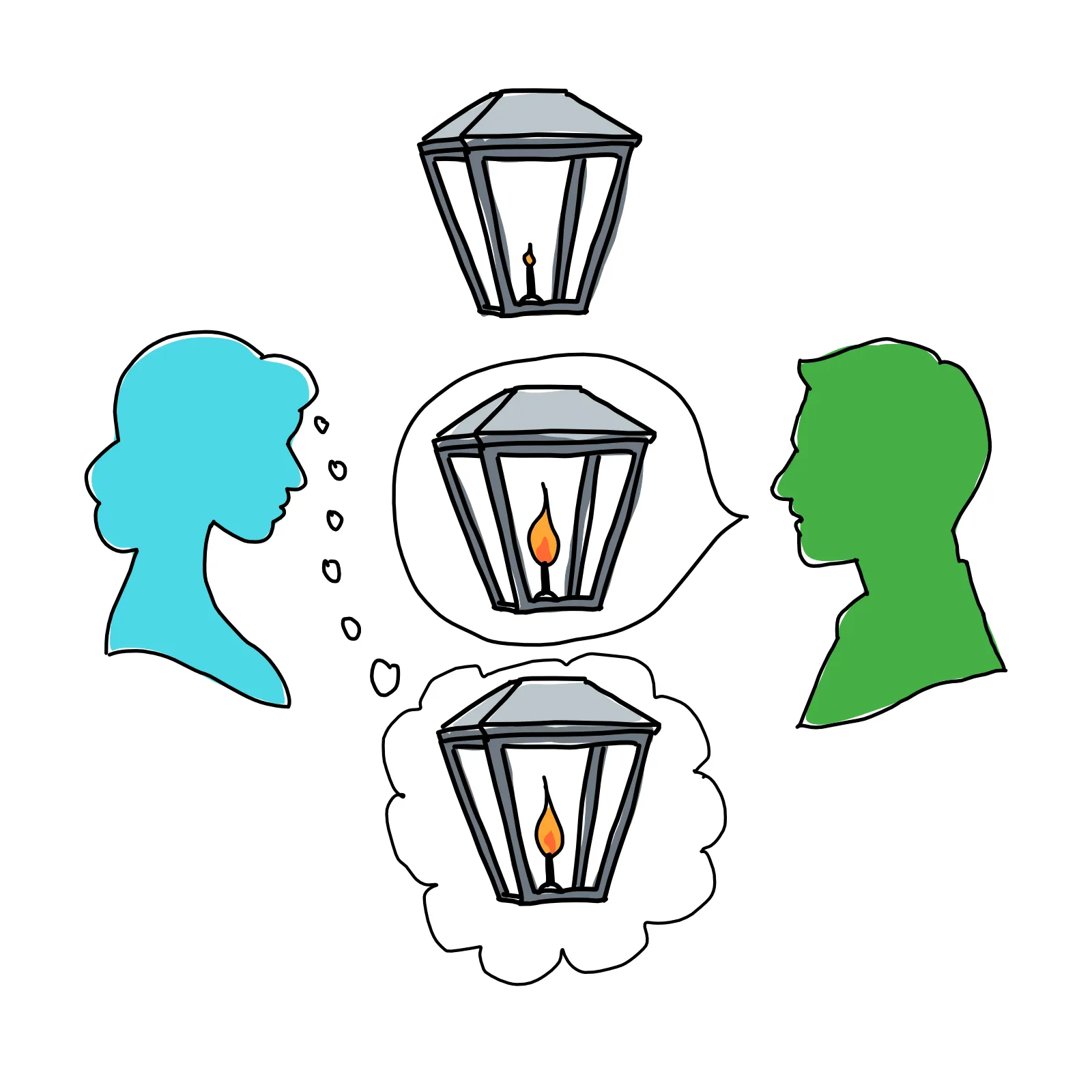
To knowingly present false information to someone, making them doubt their own observations, memory, and self-trust.
Gate's Law
The adage from Bill Gates that, "Most people overestimate what they can do in one year and underestimate what they can do in ten years."
Generation Effect
Self-Generation Effect
A phenomenon where information is better remembered if it is generated from one's own mind rather than simply read.
Group Attractiveness Effect
Cheerleader Effect
The cognitive bias which causes people to think individuals are more attractive when they are in a group.
Halcyon Days
A nostalgic reference to a past period remembered as happy, peaceful, and successful.
Halo Effect
The tendency to let one positive trait — attractiveness, confidence, a nice smile — color your judgment of a person's entirely unrelated qualities. First impressions cast a long shadow.
Hofstadter's Law
The axiom that "it always takes longer than you expect, even when you take into account Hofstadter's Law."
Humor Effect
Bizarreness Effect
The observation that humorous items are more easily remembered than non-humorous ones, which might be explained by the distinctiveness of humor itself, the act of understanding the humor, or simply the emotions that the humor causes.
Hypersonic Effect
A term coined to describe a phenomenon reported in a controversial scientific study which claims that, although humans cannot consciously hear ultrasound (sounds at frequencies above approximately 20 kHz), the presence or absence of those frequencies has a measurable effect on their physiological and psychological reactions.
Iconic Representation
The use of pictorial images to make actions, objects, and concepts in a display easier to find, recognize, learn, and remember.
Illusory Truth Effect
Illusion of Truth Effect
The notion that one is more likely to identify as true statements those they have previously heard (even if they cannot consciously remember having heard them), regardless of the actual validity of the statement. In other words, a person is more likely to believe a familiar statement than an unfamiliar one.
Imposter Syndrome
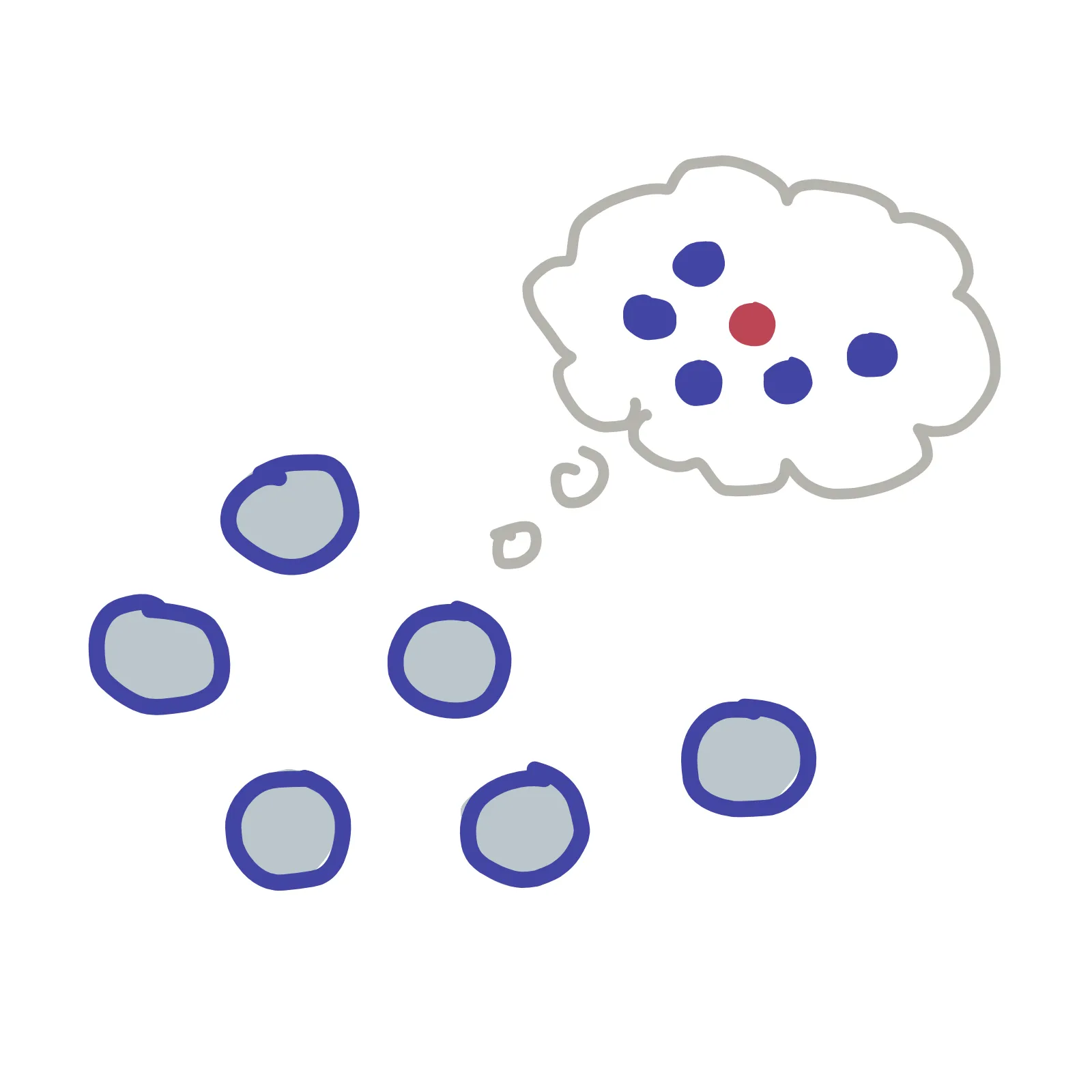
The idea (and fear) that one will be exposed as a 'fraud' in their position or for their accomplishments, even in the face of objective evidence to the contrary.
Information Bias
The tendency to seek more information even when it won't change your decision. More data feels productive but can delay action without improving outcomes.
Innsaei
Icelandic term for 'intuition', but can also mean 'the sea within' and more generally conveys a sense of inner awareness and ability to empathize with others from within one's own self.
Introspection Illusion
A cognitive bias in which people wrongly think they have direct insight into the origins of their mental states, while treating others' introspections as unreliable.
Irrelevant Speech Effect
The degradation of serial recall when speech sounds are presented, even if the list items are presented visually. The sounds need not be a language the participant understands, nor even a real language; human speech sounds are sufficient to produce this effect.
Isolation Effect
Von Restorff Effect
Predicts that when multiple homogeneous stimuli are presented, the stimulus that differs from the rest is more likely to be remembered.
Leveling and Sharpening
In memory, sharpening is usually the way people remember small details in the retelling of stories they have experienced or are retelling those stories. Leveling is when people keep out parts of stories and try to tone those stories down so that some parts are excluded.
Mandela Effect
False Memory Effect · Berenstain Bears Effect
A phenomenon in which large groups of people share the same false memory — such as many recalling Nelson Mandela dying in prison in the 1980s, when he was actually released in 1990 and died in 2013.
McCollough Effect
A phenomenon of human visual perception in which colorless gratings appear colored contingent on the orientation of the gratings. It is an aftereffect requiring a period of induction to produce it.
McGurk Effect
Perceptual phenomenon that demonstrates an interaction between hearing and vision in speech perception. The illusion occurs when the auditory component of one sound is paired with the visual component of another sound, leading to the perception of a third sound. The visual information a person gets from seeing a person speak changes the way they hear the sound.
Mental Model
An explanation of a thought process, typically in a more abstract form, about how something works in the real world.
Miller's Law
7±2 · Magical Number Seven Plus or Minus Two
The observation that the number of objects an average person can hold in working memory is about seven.
Misinformation Effect
Recall of specific memories are less accurate because of post-event information that in part over-writes or fills-in the specific memories (intentionally or not).
Missing Letter Effect
The missing letter effect refers to the finding that, when people are asked to consciously detect target letters while reading text, they miss more letters in frequent, function words (e.g. the letter "h" in "the") than in less frequent, content words.
Mnemonic Device
A learning technique that aids information retention and retrieval in memory by making use of connected encoding, and retrieval cues.
Modality Effect
The finding that how information is presented — visually, audibly, or otherwise — affects how well it's learned and remembered. The medium shapes the message.
Mood Congruent Memory Bias
The tendency to more easily recall memories that match your current emotional state. When you're sad, sad memories surface more readily — and vice versa.
Munchausen Syndrome
Factitious Disorder Imposed on Self
A factitious disorder wherein those affected feign disease, illness, or psychological trauma to draw attention, sympathy, or reassurance to themselves.
Name-Letter Effect
The tendency of people to prefer the letters in their name over other letters in the alphabet.
Next-in-Line Effect
The phenomena of people being unable to recall information concerning events immediately preceding their turn to perform.
Pareidolia
A psychological phenomenon in which the mind responds to a stimulus, usually an image or a sound, by perceiving a familiar pattern where none exists.
Part-list Cuing Effect
Memory Inhibition
The ability not to remember irrelevant information. Scientifically speaking, memory inhibition is a type of cognitive inhibition, which is the stopping or overriding of a mental process, in whole or in part, with or without intention. Also, an adaptive process, as it is essential not only to activate the relevant information, but also to inhibit irrelevant information.
Perceptual Blindness
Inattentional Blindness
Lack of attention that is not associated with any physical or instrumental defects — where objects or events that are unexpected and should be easy to notice simply are not.
Perceptual Time Dilation
Kappa Effect
A temporal perceptual illusion where in perceiving a sequence of consecutive stimuli, subjects tend to overestimate the elapsed time between two successive stimuli when the distance between the stimuli is sufficiently large, and to underestimate the elapsed time when the distance is sufficiently small.
Perruchet Effect
A psychological phenomenon in which a dissociation is shown between conscious expectation of an event and the strength or speed of a response to the event.
Physical Attractiveness Stereotype
Attractiveness Bias
A tendency, described by psychologists, to assume that people who are physically attractive also possess other socially desirable personality traits.
Picture Superiority Effect
The finding that images are far more likely to be remembered than words alone. If you want something to stick, show it — don't just say it.
Post-purchase Rationalization
Choice-Supportive Bias
A cognitive bias describing a tendency to retroactively ascribe positive attributes to an option one has selected — for example, in assigning positive values to a purchase that was recently made.
Pratfall Effect
The tendency for attractiveness to increase or decrease after an individual makes a mistake, depending on the individual's perceived ability to perform well in a general sense.
Prediction Error Minimization
The cognitive notion that our brains are fundamentally trying to minimize errors concerning their own predictions of the incoming sensory stream.
Processing Difficulty Effect
Disfluency Effect
The observation that information that takes longer to read and is thought about more is more easily remembered.
Proportionality Bias
Major Event–Major Cause Heuristic
The tendency to believe that big events must necessarily have big causes — a belief often seen in conspiracy-theory thinking as a justification for hidden coordination and groups.
Qualia
The individual instances of subjective, conscious experience, such as how one perceives of taste, or of color.
Rashomon Effect
When the same event is given contradictory interpretations by different individuals involved.
Recall Bias
Reporting Bias
A systematic error caused by differences in the accuracy or completeness of the recollections retrieved recalled by study participants regarding events or experiences from the past. For example, in studies of risk factors for cancer, people who have had the disease may search their memories more thoroughly than members of the unaffected control group.
Recency Bias
The tendency to weigh recent events or information more heavily than earlier ones, regardless of their actual significance.
Recency Illusion
The belief or impression that something (typically a word or language usage), is of recent origin when it is long-established.
Recognition Over Recall
The observation that showing users things they can recognize improves usability over needing to recall items from scratch because the extra context helps users retrieve information from memory.
Regressive Bias
Central Tendency Bias · Contraction Bias
The tendency to remember high values and high likelihoods/probabilities/frequencies lower than they actually were and low ones higher than they actually were.
Reminiscence Bump
The tendency for older adults to have increased recollection for events that occurred during their adolescence and early adulthood.
Rhyme-As-Reason Effect
Eaton-Rosen Phenomenon
A cognitive bias whereupon a saying or aphorism is judged as more accurate or truthful when it is rewritten to rhyme.
Right to Forget
The notion that individuals have a right to determine the development of their life in an autonomous way, without being perpetually or periodically stigmatized as a consequence of a specific action performed in the past.
Rosy Retrospection
Pollyanna Principle
A tendency to remember the past more positively than it actually was, judging earlier experiences as better than they seemed at the time.
Salience
The property of being noticeable or important — i.e. the perceptual quality by which an observable thing stands out relative to its environment.
Saying is Believing Effect
SIB Effect
Communicating a socially tuned message to an audience can lead to a bias of identifying the tuned message as one's own thoughts.
Selective Perception
The tendency to filter incoming information so that what aligns with existing beliefs is noticed and remembered, while what contradicts them is overlooked or quickly forgotten.
Self-Relevance Effect
A tendency for people to encode information differently depending on the level on which they are implicated in the information. When people are asked to remember information when it is related in some way to themselves, the recall rate can be improved.
Serial Position Effect
Recency Effect · Primacy Effect
The observation that we recall the first and last items in a series best, and the middle items worst.
Sleeper Effect
The phenomenon where a message becomes more persuasive over time, even if it originally came with a reason to doubt it. We forget the source but remember the claim.
Sociability Bias of Language
The phenomenon in most languages of disproportionately higher representation of words related to social and interpersonal interactions, as compared to words related to physical or mental aspects of behavior.
Source Confusion
Misattribution of Memory
The cognitive phenomenon of remembering information correctly but being wrong about the source of that information.
Spacing Effect
The observation that learning is greater when studying is spread out over time, as opposed to studying the same amount of time in a single session.
Stroop Effect
A demonstration of interference in the reaction time of a task, particularly the delayed reaction times when the color of the word doesn't match the name of the word.
Suffix Effect
A cognitive bias where when trying to hear a list of items to be remembered, which is then followed by an irrelevant item or list (the suffix), the initial list is more challenging to recall.
Superstimulus
Supernormal Stimuli
An exaggerated version of a stimulus to which there is an existing response tendency, or any stimulus that elicits a response more strongly than the stimulus for which it evolved.
Tachypsychia
A neurological condition that alters the perception of time, usually induced by physical exertion, drug use, or a traumatic event. For someone affected by tachypsychia, time perceived by the individual either lengthens, making events appear to slow down, or contracts, objects appearing as moving in a speeding blur.
Telescoping Bias
Telescoping Effect
The time displacement of an event where people perceive recent events as being more remote than they are (backward telescoping) and distant events as being more recent than they are (forward telescoping).
Testing Effect
Practice Testing
Long-term memory is improved when some of the learning period is devoted to retrieving the information.
Tetris Effect
When people devote so much time and attention to an activity that it begins to pattern their thoughts, mental images, and dreams.
Time-Saving Bias
People's tendency to misestimate the time that could be saved (or lost) when increasing (or decreasing) speed. In general, people underestimate the time that could be saved when increasing from a relatively low speed (e.g., 25 mph or 40 km/h) and overestimate the time that could be saved when increasing from a relatively high speed (e.g., 55 mph or 90 km/h).
Tip of the Tongue Phenomenon
The phenomenon of not being able to retrieve a word from memory, combined with the sense of being on the cusp of being able to retrieve it.
Umwelt
An organism's subjective model of the world, shaped by the capabilities of its particular sensory organs and perceptual systems. Though organisms may share the same physical environment, each inhabits a distinct perceptual reality.
Verbal Overshadowing
The phenomenon where giving a verbal description of a face (or other complex stimuli) impairs recognition of that face or stimuli.
Verbatim Effect
The observation that the "gist" of what someone has said is better remembered than the verbatim wording.
Wagon-Wheel Effect
Stroboscopic Effect · Temporal Aliasing
An optical illusion where a spinning wheel appears to slow down, stop, or reverse direction — caused by the frame rate of perception or recording not matching the rotation speed.
Weber-Fechner Law
Steven's Power Law
A proposed relationship between the magnitude of a physical stimulus and the intensity or strength that people feel, suggesting the relationship between stimulus and perception is logarithmic.
Well-Traveled Road Effect
Experience Curve Effects
Cognitive bias where one underestimates the duration in traveling an often-used route, and overestimates the duration taken in traveling less familiar ones.
Word Frequency Effect
A psychological phenomenon where recognition times are faster for words seen more frequently than for words seen less frequently.
Word Superiority Effect
The phenomenon that people have better recognition of letters presented within words as compared to isolated letters and to letters presented within nonword (orthographically illegal, unpronounceable letter array) strings.
Zone of Proximal Development
The gap between what a learner can do independently and what they can achieve with guidance. Real learning happens in this stretch zone.